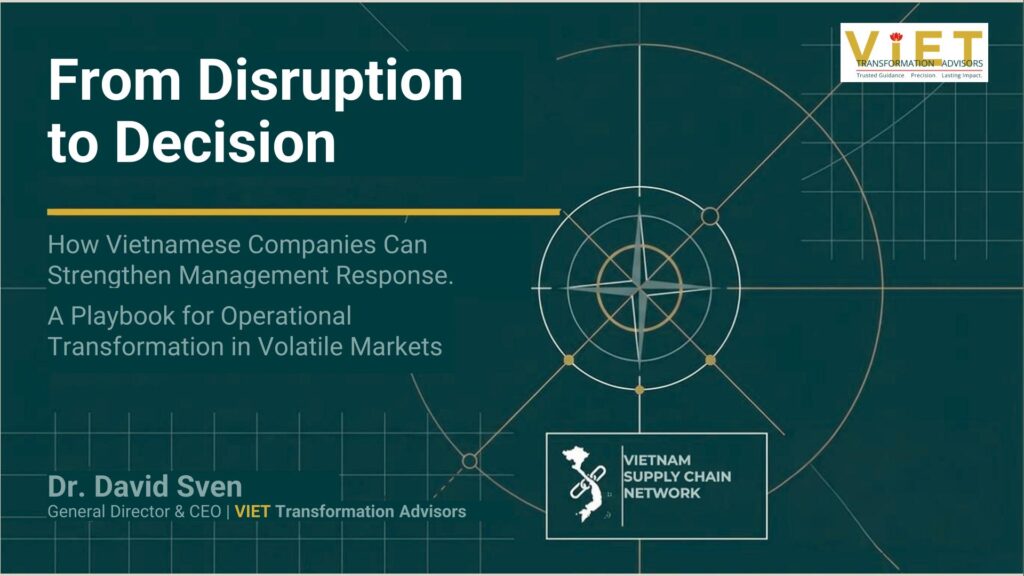

From Disruption to Decision: Strengthening Management Response in Times of Volatility
From Disruption to Decision: Strengthening Management Response in Times of Volatility ViEt-TA was pleased to contribute to VSCN Talk #18, […]
Vietnam’s growth story remains strong — but the environment for businesses is becoming more selective. As capital discipline increases and banks strengthen risk management, companies will increasingly be judged not only by growth potential, but by operational resilience, financial transparency, and execution capability.
This article explores why the next phase of Vietnam’s economic development may reward disciplined, adaptable companies more than rapid expansion alone — and why operational restructuring, liquidity control, and early strategic adjustment are becoming critical competitive advantages.
As Vietnamese companies continue expanding, many are discovering that growth alone no longer guarantees operational strength. Increasing complexity, fragmented processes and slower decision-making are quietly reducing efficiency and profitability inside organisations. The next competitive advantage may not simply be faster growth — but clearer operations, stronger execution discipline and the ability to scale without losing control.
Many Vietnamese companies are currently experiencing a subtle but significant shift: revenue remains stable, yet profitability weakens. Orders continue, customers are present, and operations stay active — but margins thin out, decisions slow down, and the familiar logic of growth feels less reliable. This is not a downturn; it is an in‑between phase where activity no longer guarantees economic stability.
Vietnam has officially launched its International Financial Centre (IFC), signaling a deliberate transition from ambitious concept to a functioning institution. Rather than a sudden breakthrough, the move reflects Vietnam’s trademark “gradualist approach,” focusing on institutional credibility and long-term stability over mere symbolism.
Vietnam’s export sector is entering a structurally different operating environment. What was once a logistics issue—shipment delays and route volatility—has escalated into a core management challenge affecting delivery reliability, working capital, and customer trust.
Vietnam’s new International Financial Centre is not about speed or spectacle. It is about credibility, governance, and disciplined implementation. From legal architecture to fintech sandboxes, the IFC reflects Vietnam’s patient, institution-by-institution path to international financial maturity.
Vietnam is entering a decisive phase where policy clarity, private-sector momentum, and disciplined execution are reshaping the country’s economic trajectory.
𝐓𝐡𝐞 𝐫𝐞𝐬𝐡𝐚𝐩𝐢𝐧𝐠 𝐨𝐟 𝐔𝐒 𝐚𝐧𝐝 𝐄𝐮𝐫𝐨𝐩𝐞𝐚𝐧 𝐅𝐃𝐈 𝐬𝐭𝐫𝐚𝐭𝐞𝐠𝐢𝐞𝐬 𝐢𝐧 𝐕𝐢𝐞𝐭𝐧𝐚𝐦 underscores a decisive shift from 𝐜𝐨𝐬𝐭-𝐝𝐫𝐢𝐯𝐞𝐧 𝐝𝐞𝐜𝐢𝐬𝐢𝐨𝐧𝐬 to 𝐬𝐲𝐬𝐭𝐞𝐦𝐢𝐜 𝐫𝐞𝐬𝐢𝐥𝐢𝐞𝐧𝐜𝐞
Vietnam’s tourism is soaring in 2025 with 15.43 million international arrivals by September — a clear sign of post-pandemic recovery.